
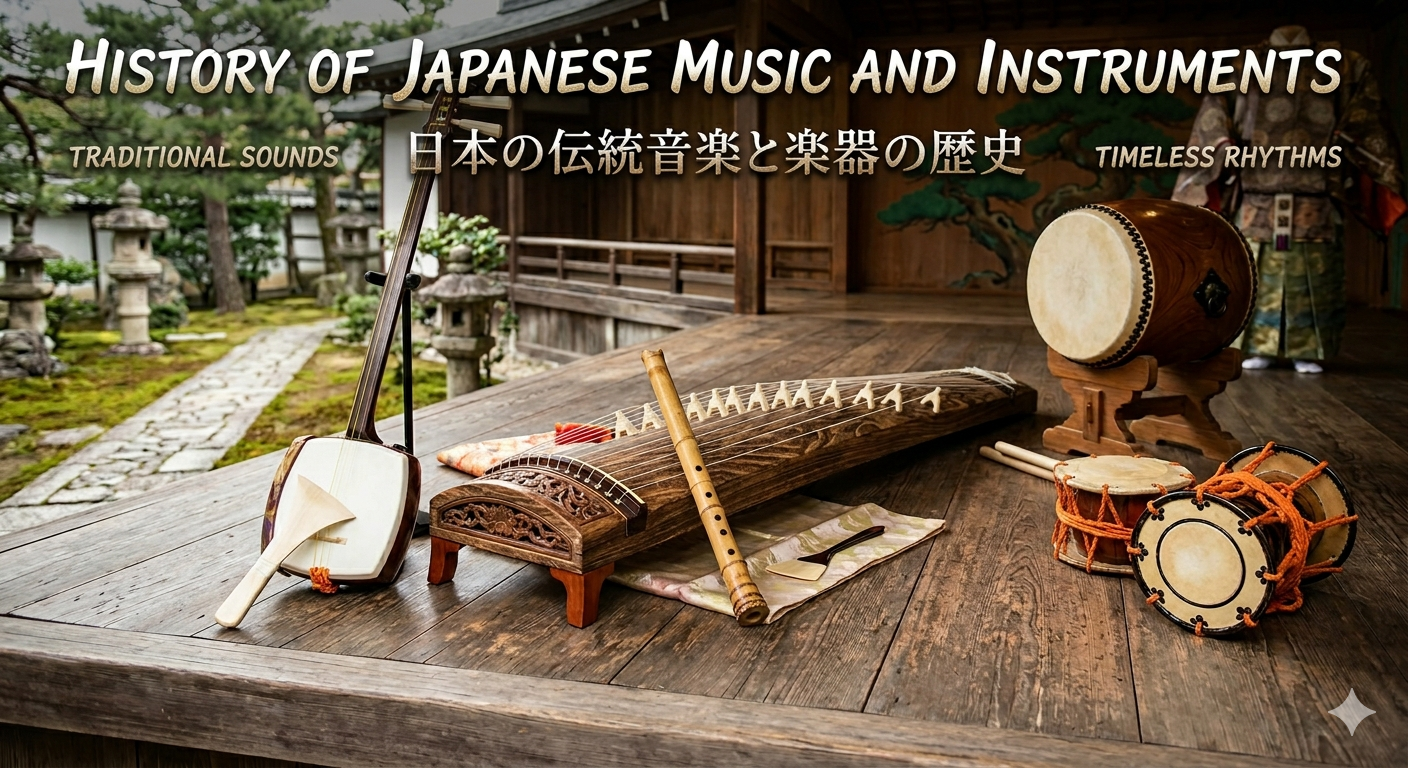
When you think of Japan, you might picture the neon lights of Tokyo or the serene temples of Kyoto. But if you listen closely, there is a soundtrack that has been playing for over a thousand years. The history of Japanese music and instruments is a fascinating journey of transformation—where ancient continental influences met a unique island spirit to create something entirely original.
In this guide, we’ll explore the evolution of Japanese sounds, from the ritualistic beats of the Jomon period to the elegant strings of the Edo era.
1. Ancient Echoes: The Roots of Japanese Sound
As Japan moved into the Nara (710–794) and Heian (794–1185) periods, the musical landscape changed forever. This was the era of Gagaku—the oldest classical music in the world still performed today.
The Rise of Gagaku
Gagaku, or “elegant music,” was the music of the Imperial Court. It wasn’t purely Japanese; it was a “melting pot” of sounds from China, Korea, and even India.
• Key Instruments: The Sho (a mouth organ representing the light of heaven) and the Hichiriki (a double-reed flute representing the voice of the earth).
2. The Icons: Must-Know Traditional Japanese Instruments
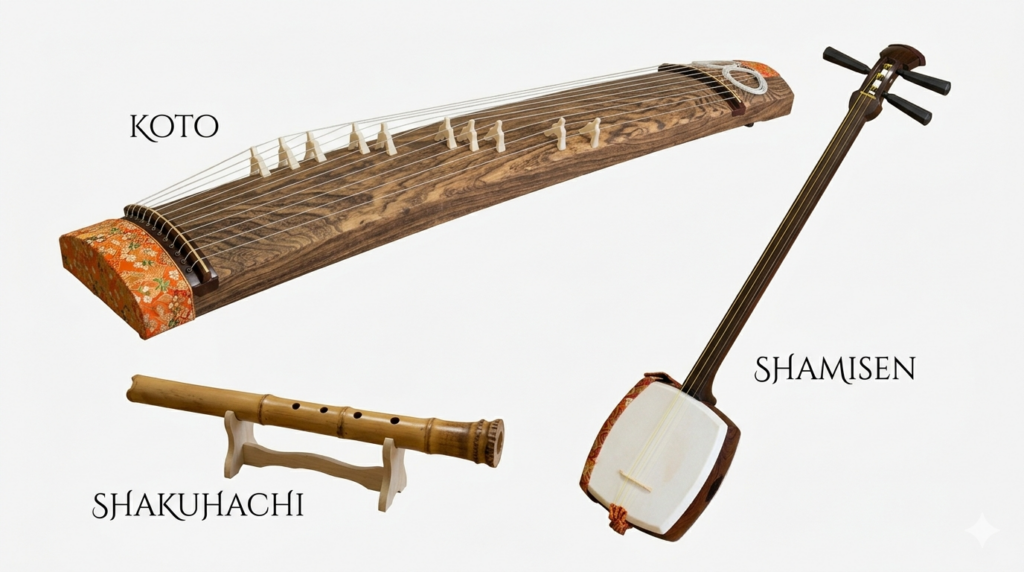
Traditional Japanese instruments, known as Wagakki, are categorized by their materials—wood, skin, and silk. Here are the “Big Three” that define the Japanese sound:
The Koto (Japan’s National Instrument)
The Koto is a long, 13-stringed zither made of Paulownia wood. Introduced from China in the 7th century, it was originally a court instrument before becoming a staple for the merchant class.
• The Sound: Graceful, resonant, and often described as “rippling water.”
The Shamisen (The Three-Stringed Lute)
Introduced via Okinawa in the 16th century, the Shamisen is perhaps the most versatile instrument in Japanese history. It became the backbone of Kabuki theater and folk songs (Min’yo).
• The Style: Played with a large plectrum called a bachi, it can sound percussive and aggressive or soft and melodic.
The Shakuhachi (The Zen Flute)
The Shakuhachi is a longitudinal end-blown flute made of bamboo. In the Edo period, it was famously played by “Komuso” monks—wandering Zen priests who used the flute as a tool for “blowing zen” (suizen) meditation.
3. Medieval Dramas: Noh and the Samurai
As the Samurai class rose to power in the Muromachi Period (1336–1573), music became more theatrical. This era saw the birth of Noh, a highly stylized musical drama.
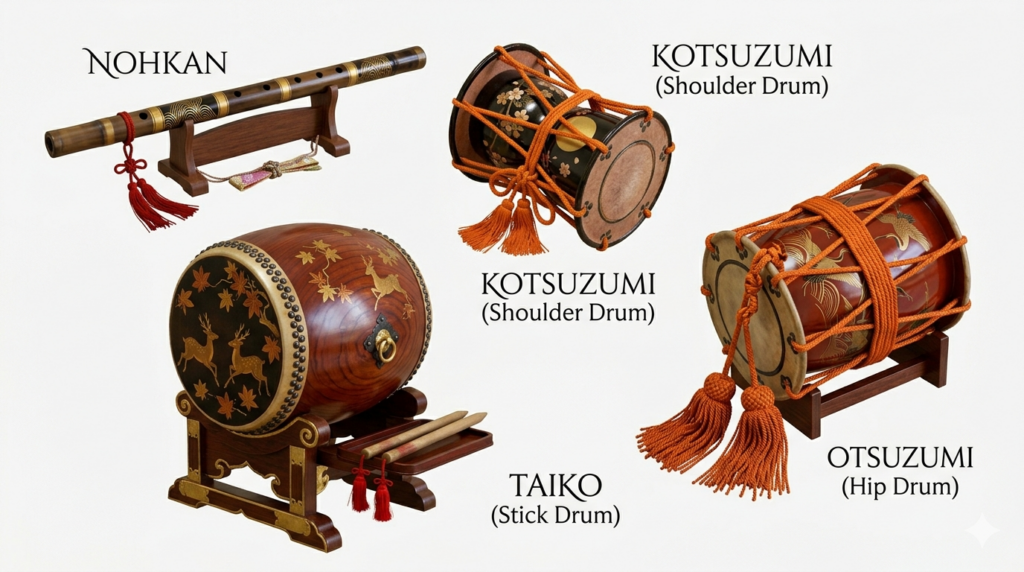
Noh music, or Hayashi, relies on a minimalist ensemble:
• The Flute: Nohkan
• The Drums: Kotsuzumi (shoulder drum), Otsuzumi (hip drum), and Taiko (stick drum).
The focus shifted to Ma—the concept of negative space or silence. In Japanese music, the silence between the notes is just as important as the notes themselves.
4. The Golden Age: The Edo Period (1603–1868)
The Edo period was a time of peace and isolation, which allowed a distinct “pop culture” to flourish. Music moved from the courts to the streets.
• Geisha Culture: The Shamisen became the primary instrument for Geisha entertainment.
• Koto Schools: Blind musicians like Yatsuhashi Kengyo revolutionized Koto music, moving it away from the court and into the homes of common people.
| Era | primary style | key instruments |
| Heian | Gagaku (Court Music) | Sho, Hichiriki |
| Muromachi | Noh (Theater) | Nohkan, Tsuzumi |
| Edo | Kabuki & Folk | Shamisen, Koto |
5. Modern Japan: A Fusion of East and West
With the Meiji Restoration (1868), Western classical music flooded Japan. However, the history of Japanese music didn’t end; it adapted.
Today, you can hear the Taiko (massive drums) at local festivals (Matsuri), or see “Wagakki Bands” that blend heavy rock with the Shamisen and Koto. The ancient sounds of Japan continue to resonate in modern film scores and video game soundtracks, proving that these instruments are as timeless as the culture itself.
Conclusion: Experience the Sound
Understanding the history of Japanese music and instruments is like peeling back the layers of Japan’s soul. Whether it’s the meditative breath of a Shakuhachi or the thunderous roar of a Taiko drum, these sounds carry the weight of centuries.

コメント